How Much Does a Military Rucksack Weigh?
Short Answer
There is no single number, because the load changes with the job. These are the figures that matter:
| Situation | Typical weight |
|---|---|
| Graded Army ruck march (pack only) | 35 lbs |
| Fighting load (what you fight in) | 35–50 lbs |
| Approach march load | 60–72 lbs |
| Real operational load | 80–100+ lbs |
| Empty rucksack alone | 7–11 lbs |
The Three Load Tiers
Army doctrine does not describe "a rucksack weight." It describes load tiers, each with a planning ceiling, because what a soldier carries depends on whether they expect to fight in the next hour or walk for three days.
| Load tier | Doctrinal planning ceiling | What it covers |
|---|---|---|
| Fighting load | ~48 lbs | Weapon, ammunition, armour, helmet, water, fighting essentials |
| Approach march load | ~72 lbs | Fighting load plus the rucksack needed to reach the objective |
| Emergency approach march load | 120 lbs+ | Everything, when no transport exists — expected to degrade the soldier |
Two things are worth understanding about those numbers. First, they are ceilings for planners, not targets: doctrine treats them as the point beyond which performance falls off, not a weight to aim for. Second, they are routinely exceeded in practice. Documented loads from Iraq and Afghanistan regularly ran past 100 lbs once plates, batteries, optics, radios and water were added, which is exactly the problem the doctrine warns about.
Rucksack Weight by Branch and School
Graded events use a fixed, verified pack weight so that everyone is tested on the same load. Operational weights are far less tidy.
| Branch / school | Graded pack weight | Typical total carried |
|---|---|---|
| U.S. Army (12-mile standard) | 35 lbs | 50–65 lbs with gear |
| Air Assault School | ~35 lbs | 50–65 lbs with weapon and armour |
| RASP (75th Ranger Regiment) | ~45 lbs | 60–75 lbs |
| Ranger School (by phase) | No fixed test weight | 45–90 lbs |
| SFAS (Special Forces) | ~45 lbs | 55–70 lbs |
| Marine Corps hikes | ~45–55 lbs | 70–100+ lbs in the fleet |
The pattern is consistent: the graded number is the floor, and the field number is roughly double it. For the full time and pace requirements behind each of these, see our military ruck standards guide, or the dedicated breakdowns for Ranger, Marine Corps and Air Assault standards.
What Makes Up the Weight
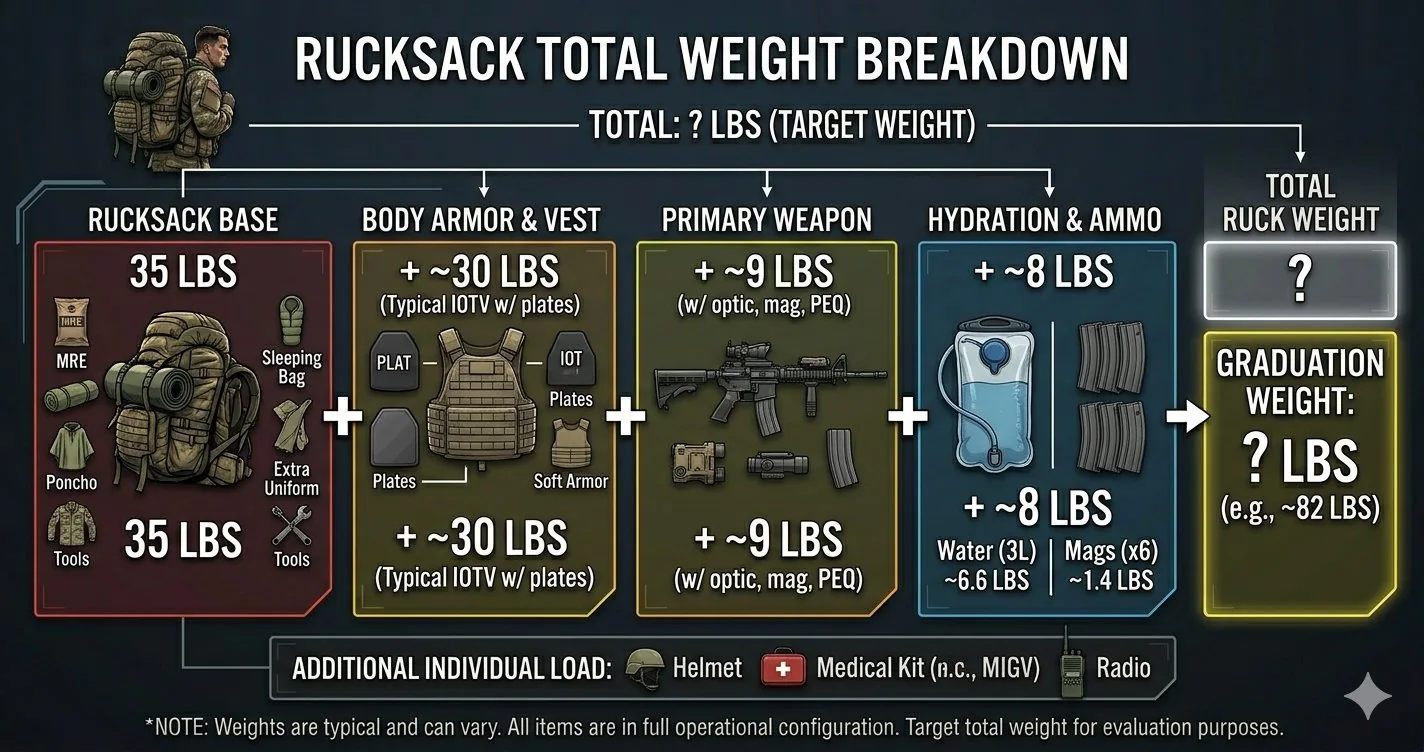
Nothing in a combat load is individually outrageous. The total is what hurts. Here is how a realistic 80 lb load assembles itself:
| Item | Weight |
|---|---|
| Rucksack (empty, with frame) | ~10 lbs |
| Body armour with plates | 25–30 lbs |
| Helmet | 3–4 lbs |
| Rifle and basic ammunition load | 15–20 lbs |
| Water (3 litres) | ~6.6 lbs |
| Sleep system and shelter | 6–10 lbs |
| Rations (3 days) | ~6 lbs |
| Batteries, optics, radio, night vision | 5–15 lbs |
Water is the item people underestimate: it weighs roughly 2.2 lbs per litre, so a full 3-litre bladder is nearly seven pounds that you drink away over the march. Batteries are the modern equivalent — night vision, radios and optics have quietly added five to fifteen pounds to the infantry load over the last two decades.
What an Empty Military Rucksack Weighs
Before anything goes inside, the pack itself costs you weight. That matters when a graded standard specifies a total.
| Pack system | Service | Empty weight |
|---|---|---|
| MOLLE II large rucksack (with frame) | Army | ~10 lbs |
| MOLLE 4000 | Army | ~9–10 lbs |
| FILBE main pack | Marine Corps | ~9–10 lbs |
| ALICE large pack with frame (legacy) | Army (historic) | ~7–8 lbs |
| Civilian rucking pack (e.g. 25L) | — | ~3–4 lbs |
This is why soldiers hitting a 35 lb graded standard often pack around 25–27 lbs of contents: the frame and pack already account for the rest. Weight is verified at the start line, so packing to the number rather than guessing is the norm.
Why Military Rucks Are So Heavy
The honest answer is that every capability has a mass, and nobody wants to be the one who left theirs behind. Armour stops rounds but costs 25–30 lbs. Night vision wins the dark but needs batteries. Radios buy coordination at the price of weight. Each decision is individually defensible; collectively they produce a load that slows the soldier carrying it.
This is a measured, not theoretical, problem. Load-carriage research — the same body of work that produced the Pandolf equation used in our rucking calorie calculator — shows that metabolic cost rises out of proportion to the load once the pack passes roughly 30 percent of body weight. For a 180 lb soldier that threshold is about 54 lbs, well below a normal approach march load.
The practical consequences are slower movement, earlier fatigue and a sharply higher rate of overuse injury, particularly to the knees, lower back and feet. Doctrine's load ceilings exist precisely because of these findings.
How This Compares to Civilian Rucking
If you are rucking for fitness rather than for a unit, military numbers are a poor starting point. A soldier carries 60 lbs because the mission demands it, not because it is the optimal training stimulus.
For fitness the useful range is 10–20 percent of body weight — roughly 18–36 lbs for a 180 lb person — which delivers most of the aerobic and strength benefit at a fraction of the injury risk. Work up from the bottom of that range, adding no more than about 5 lbs every two to three weeks.
To pick a starting load for your bodyweight and experience, use our ruck weight calculator, and see the ruck weight guide for how to progress it safely. If you are training toward a military standard specifically, the 12-mile ruck standard guide covers the pace and splits you need.
Frequently Asked Questions
How much does a military rucksack weigh?
It depends on the task. For a graded Army ruck march the pack is 35 lbs. A fighting load runs about 35 to 50 lbs, an approach march load about 60 to 72 lbs, and real operational loads in the field frequently reach 80 to 100-plus pounds once armour, water, ammunition and mission equipment are added.
How heavy is a soldier's backpack?
A typical US soldier's rucksack weighs 35 lbs for a standard graded foot march and 60 to 100 lbs on operations. Army doctrine sets planning ceilings of roughly 48 lbs for a fighting load and 72 lbs for an approach march load, though documented combat loads have often exceeded both.
What is the standard Army ruck weight?
The standard graded Army ruck march is 12 miles carrying a minimum of 35 lbs in the rucksack, completed in under 3 hours. That 35 lbs is the dry pack weight and does not include the weapon, helmet, body armour or water, which push the total carried weight to roughly 50 to 65 lbs.
How much does an empty military rucksack weigh?
Empty pack weights run about 10 lbs for the Army MOLLE II large rucksack with frame, roughly 9 to 10 lbs for the Marine Corps FILBE main pack, and about 7 to 8 lbs for the older ALICE large pack. That empty weight counts against your load before you pack a single item.
Why are military rucksacks so heavy?
Weight accumulates from items that are individually reasonable: body armour with plates is 25 to 30 lbs, a weapon and ammunition 15 to 20 lbs, water about 2 lbs per litre, plus batteries, optics, radios, food and sleep gear. Doctrine warns that loads above roughly 30 percent of body weight measurably degrade speed and endurance.
Find Your Own Ruck Weight
Military loads are set by the mission. Yours should be set by your bodyweight and experience.
Open the Weight Calculator →Sources & Methodology
This guide was compiled and fact-checked by The Ruck Calculator editorial team. Load tiers and planning ceilings are drawn from US Army foot-march doctrine; equipment weights are typical issued figures and vary by model, size and configuration. Confirm current requirements with your chain of command before any graded event.
- Headquarters, Department of the Army. ATP 3-21.18, Foot Marches.
- Headquarters, Department of the Army. FM 7-22, Holistic Health and Fitness.
- Pandolf, K.B., Givoni, B., & Goldman, R.F. (1977). "Predicting energy expenditure with loads while standing or walking very slowly." Journal of Applied Physiology, 43(4), 577–581.