Rucking Calorie Calculator
See exactly how many calories you burn rucking. Enter your body weight, ruck weight, distance, and time, and this calculator uses the Pandolf load-carriage equation to estimate calories burned, calories per mile, and how much more you burn than walking the same route unloaded. Works in pounds or kilograms.
Calculator Input
Calories Burned Rucking by Body Weight and Load
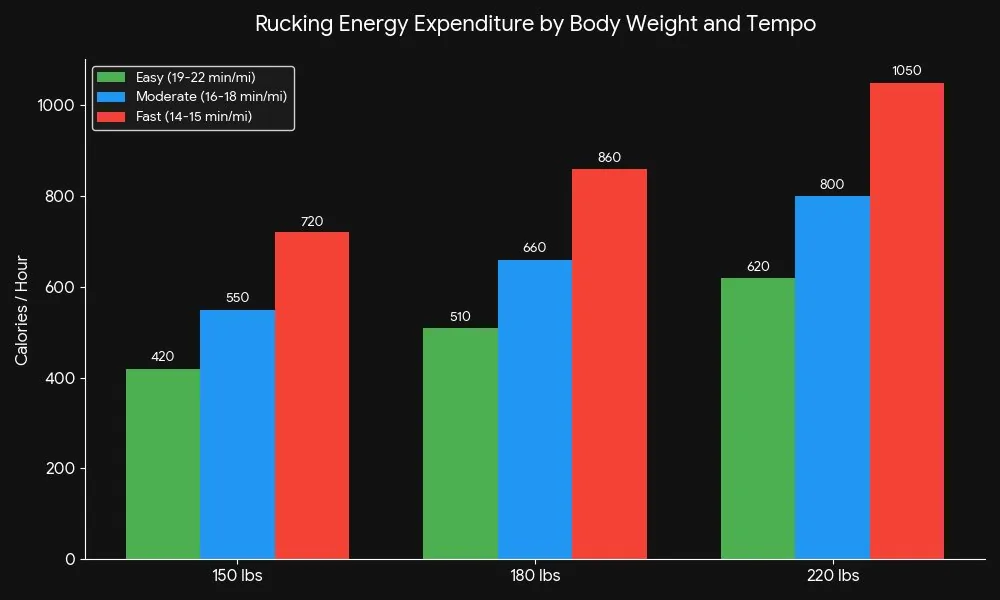
The table below shows approximate calories burned per mile at a 15-minute-mile pace on flat, firm ground, using the same Pandolf model as the calculator. Use it as a quick reference; the tool above gives a figure tailored to your exact numbers.
| Body weight | No load | 20 lb ruck | 35 lb ruck | 50 lb ruck |
|---|---|---|---|---|
| 130 lbs | ~80 | ~90 | ~99 | ~108 |
| 160 lbs | ~98 | ~108 | ~116 | ~126 |
| 180 lbs | ~111 | ~120 | ~129 | ~137 |
| 200 lbs | ~123 | ~133 | ~141 | ~149 |
| 230 lbs | ~141 | ~151 | ~159 | ~167 |
Figures are rounded gross-energy estimates (they include the calories you would burn just being alive during that time). To turn per-mile numbers into a session total, multiply by your distance — a 180 lb rucker carrying 35 lbs for 4 miles burns roughly 520 calories (129 × 4).
How Rucking Burns Calories: The Pandolf Equation
This calculator does not use a generic "steps × MET" shortcut. It uses the Pandolf load-carriage equation, published by Pandolf, Givoni, and Goldman in 1977 and still used in military load planning. It estimates the metabolic rate of walking under a pack from five inputs: your body mass, the load, your walking speed, the terrain, and the grade.
The key insight is the load term. The equation penalizes the pack by the square of the load-to-bodyweight ratio, which is why heavier rucks raise the burn faster than their weight alone suggests. It also scales energy cost with the square of your speed, so walking faster under load is metabolically expensive, and it multiplies the whole thing by a terrain factor — sand and soft snow cost far more than pavement.
The result is converted from watts to calories per hour and multiplied by your time on feet. For a deeper breakdown of how weight, pace, and distance interact, see our rucking for weight loss guide and the pace guide.
Rucking vs Walking vs Running Calories
Rucking sits in a useful middle ground. It burns far more than ordinary walking because of the load, and it approaches running for many people — but at a fraction of the joint impact.
- Walking (no load): the baseline. Comfortable, low burn.
- Rucking: roughly 15–35% more calories than walking the same route, scaling with how heavy the load is relative to your bodyweight. A 35 lb pack is a common training weight.
- Running: usually burns the most per mile, but with high impact and a pace many people cannot sustain under load.
Because rucking lets you add intensity through weight rather than speed, it is a low-impact way to push energy expenditure up without pounding your knees. For a full side-by-side, read rucking vs running and rucking vs walking.
How to Burn More Calories Rucking
Add weight (carefully)
Because the Pandolf load term is squared, adding weight is the most efficient way to raise burn. But progress slowly — about 5 lbs every 2–3 weeks — to protect your joints and connective tissue. Use our ruck weight calculator to find a safe starting load.
Pick rougher terrain or a hill
Trading pavement for trail, grass, or sand multiplies the energy cost, and even a modest uphill grade raises burn sharply. A hilly loop burns far more than the same distance on a flat road.
Go farther, not just faster
Total calories scale directly with distance. Adding a mile is a reliable way to bank more burn without the injury risk of chasing a faster pace under load. Plan distances with the distance calculator.
Frequently Asked Questions
How many calories does rucking burn?
Rucking typically burns 400 to 900 calories per hour depending on body weight, load, pace, and terrain. A 180 lb person rucking with 35 lbs at a 15-minute-mile pace burns roughly 500 to 600 calories per hour — about 15 to 25 percent more than walking the same route with no pack.
Does rucking burn more calories than walking?
Yes. Carrying a loaded pack raises the energy cost of every step, so rucking burns roughly 15 to 35 percent more calories than walking the same distance and pace unloaded, scaling with how heavy the load is relative to your bodyweight. The heavier the load and the steeper or softer the route, the larger the gap.
How accurate is this rucking calorie calculator?
It uses the Pandolf load-carriage equation, a validated model for the metabolic cost of walking under load. It is a strong estimate for steady walking on firm ground. Individual results vary with fitness, efficiency, heat, and footing, so treat the number as a close approximation rather than an exact measurement.
Does ruck weight change calories burned a lot?
More than most people expect. The model penalizes load by the square of the load-to-bodyweight ratio, so the extra burn grows faster than the weight you add. Going from 20 lbs to 40 lbs adds noticeably more than double the extra calories for most people.
Can I use this calculator in kg?
Yes. Switch the body weight and ruck weight units to kilograms and the distance to kilometers. The calculator converts everything internally before applying the equation, so the result is the same either way.
Sources & Methodology
This calculator and guide were built and fact-checked by The Ruck Calculator editorial team. Calories are estimated with the Pandolf load-carriage equation, a model developed for U.S. Army load planning. Results are close approximations for steady walking on firm ground; individual burn varies with fitness, efficiency, heat, and footing.
- Pandolf, K.B., Givoni, B., & Goldman, R.F. (1977). "Predicting energy expenditure with loads while standing or walking very slowly." Journal of Applied Physiology, 43(4), 577–581.
- Headquarters, Department of the Army. TC 3-21.18, Foot Marches.