Rucking Distance Calculator
Calculate how far you'll ruck given your time and pace. Perfect for planning routes, estimating training volumes, and optimizing your rucking workouts.
Calculator Input
Rucking Distance Examples by Time and Pace
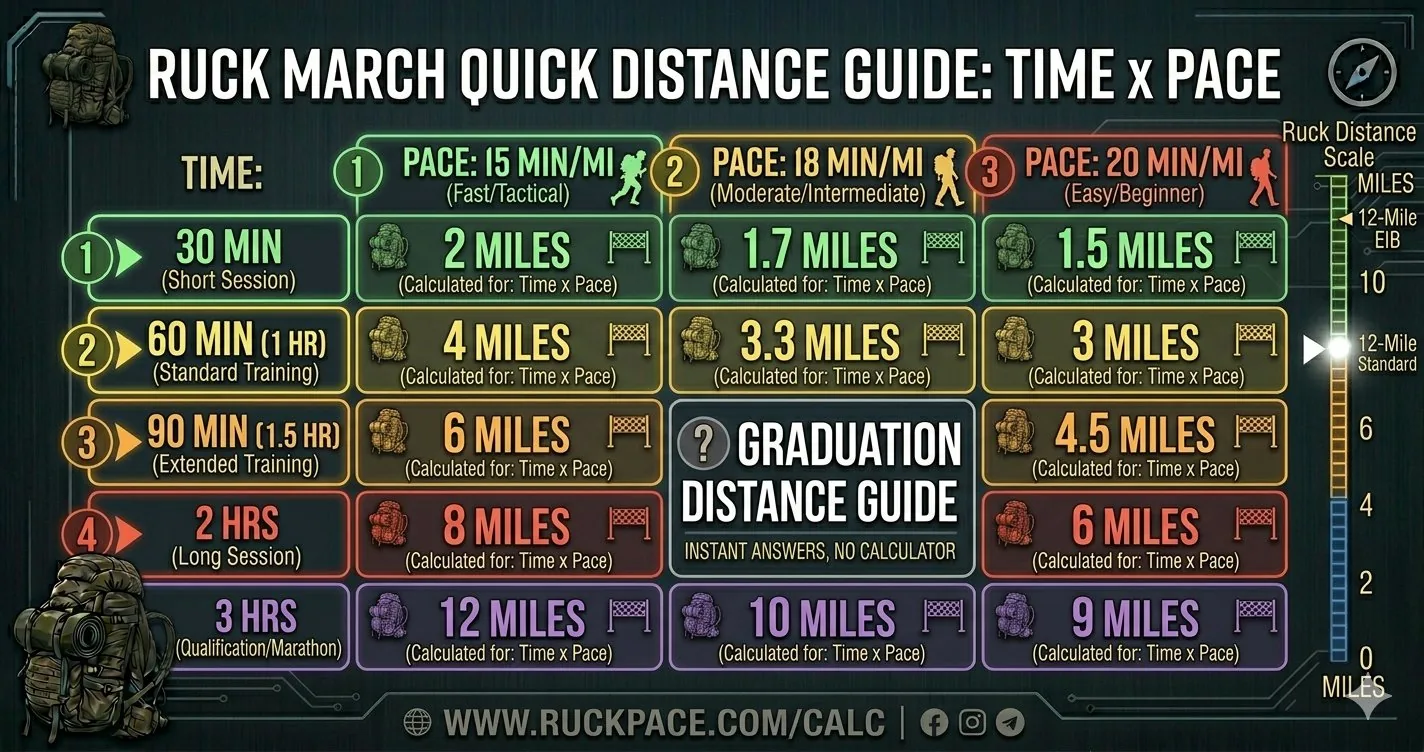
Use these examples to understand the relationship between time, pace, and distance covered during rucking sessions.
| Time | Pace | Distance | Calories* |
|---|---|---|---|
| 1 hour | 18 min/mile | 3.3 miles | ~580 cal |
| 1 hour | 15 min/mile | 4.0 miles | ~700 cal |
| 90 min | 18 min/mile | 5.0 miles | ~875 cal |
| 90 min | 15 min/mile | 6.0 miles | ~1,050 cal |
| 2 hours | 18 min/mile | 6.7 miles | ~1,170 cal |
| 2 hours | 15 min/mile | 8.0 miles | ~1,400 cal |
*Calories estimated for 180 lb person with 30 lb ruck
Understanding Rucking Distance and Pace
The Distance Formula
Calculating rucking distance is straightforward: Distance = Time ÷ Pace. Your time should be in minutes, and pace is measured in minutes per mile. For example, 90 minutes at 18 minutes per mile equals 5 miles (90 ÷ 18 = 5).
What Affects Your Rucking Pace?
Ruck Weight: Heavier loads slow your pace significantly. Every additional 10 pounds typically adds 1-2 minutes per mile. A 20 lb ruck might allow 15 min/mile pace, while 40 lbs could slow you to 18-20 min/mile.
Terrain: Flat surfaces allow faster paces (13-16 min/mile), while hills, trails, and uneven terrain can slow you to 18-22 min/mile. Sand and soft surfaces are even more challenging.
Fitness Level: As your conditioning improves, you'll naturally maintain faster paces with the same weight. Beginners often start at 20 min/mile and progress to 15-17 min/mile with training.
Weather Conditions: Heat, humidity, cold, and wind all impact pace. Extreme conditions can slow your pace by 10-20%, requiring adjustments to your distance expectations.
Planning Your Ruck Routes
Time-Based vs Distance-Based Training
Many ruckers prefer time-based training over distance goals. Time-based sessions ensure consistent training load regardless of terrain or conditions, while distance-based goals can lead to overexertion when faced with challenging routes.
Using Distance Calculations for Route Planning
Once you know your target distance, use mapping tools to plan routes. For urban rucking, city blocks average 250-350 feet, so 15-20 blocks equal approximately one mile. For trail rucking, account for elevation gain - every 100 feet of climbing adds roughly 0.1 miles to perceived difficulty.
Building Progressive Distance
Follow the 10% rule: increase weekly distance by no more than 10% to minimize injury risk. If you're currently covering 12 miles per week, add no more than 1.2 miles the following week. This gradual progression builds sustainable endurance.
Sample Weekly Distance Progressions
Beginner (Starting): Week 1: 6 miles total (3 sessions × 2 miles). Progress to 15-18 miles by week 12.
Intermediate: 18-25 miles per week across 3-4 sessions. Mix shorter intense rucks (3-4 miles) with one longer session (8-10 miles).
Advanced: 25-35+ miles per week. Include one long ruck (12-15 miles), two medium rucks (6-8 miles), and 1-2 shorter intense sessions (3-5 miles with heavy weight).
Optimizing Distance and Pace for Goals
Endurance Building
Focus on increasing total distance at comfortable paces (18-20 min/mile). Prioritize time on your feet over speed. Long, slow distance builds aerobic base and conditions connective tissue for more intense training.
Speed Development
Once you have solid endurance base, incorporate faster paces (13-15 min/mile) over shorter distances. Interval training works well: alternate between 0.5 miles at goal pace and 0.5 miles recovery pace.
Weight Loss Focus
Total distance matters more than pace for calorie burn. A 6-mile ruck burns similar calories whether completed at 15 or 18 min/mile pace. Choose sustainable paces that allow you to complete your target distance consistently.
Event Preparation
If training for specific events (like GORUCK challenges), match training distances to event requirements. Build to 110-120% of event distance at slightly slower than goal pace, then taper before the event.
Frequently Asked Questions
How accurate are distance calculations?
Distance calculations from time and pace are highly accurate on measured routes at consistent paces. Variations occur with pace changes, stops, and terrain. GPS tracking provides the most accurate verification of distances covered.
Should I ruck for time or distance?
Time-based rucking is generally better for beginners and general fitness. It ensures consistent training stimulus regardless of pace variations. Distance-based goals work well for experienced ruckers training for specific events with distance requirements.
How do I improve my rucking pace?
Improve pace through: (1) Regular training with progressive overload, (2) Reducing ruck weight temporarily for speed sessions, (3) Incorporating interval training, (4) Strengthening leg muscles with squats and lunges, and (5) Practicing efficient walking mechanics.
What pace should beginners target?
Beginners should start with comfortable conversational pace, typically 18-20 minutes per mile with light loads (10-15 lbs). Don't rush pace progression - focus on completing target times before worrying about speed.
How does distance relate to calorie burn?
Calorie burn correlates strongly with distance. A 180 lb person carrying 30 lbs burns approximately 175 calories per mile regardless of pace. A 6-mile ruck burns around 1,050 calories whether completed in 90 minutes or 2 hours.