Rucking Pace Calculator
Calculate your rucking pace (minutes per mile) from distance and time. Track your speed, monitor training progress, and compare your performance against beginner to elite standards.
Calculator Input
Rucking Pace Standards by Level
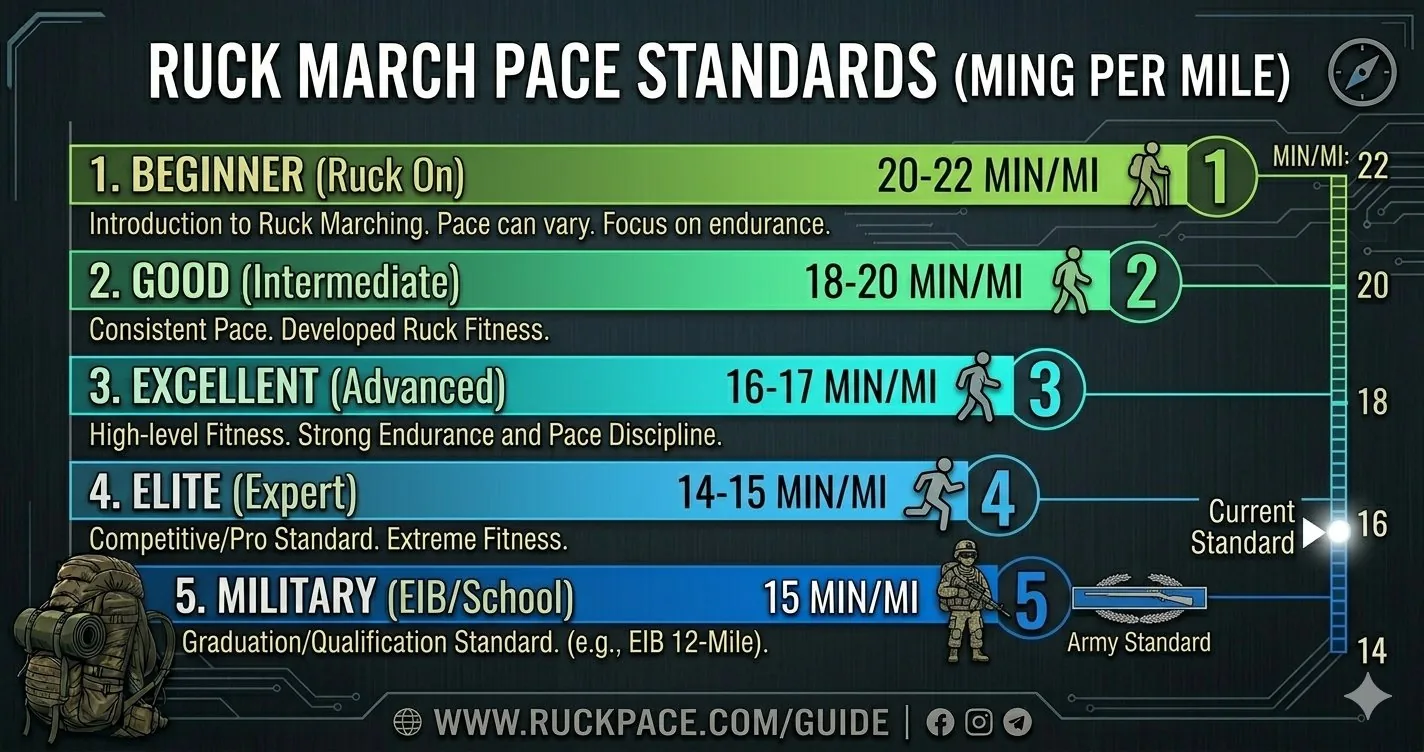
Compare your pace against these benchmarks based on 30 lb ruck weight. Lighter loads allow faster paces, while heavier loads slow pace by 1-2 min/mile per 10 lbs added.
| Level | Pace (30 lbs) | Description |
|---|---|---|
| Beginner | 20-22 min/mile | Starting out, building base fitness |
| Good | 18-20 min/mile | Regular training, solid endurance |
| Excellent | 16-17 min/mile | Advanced fitness, consistent training |
| Elite | 14-15 min/mile | Competition level, exceptional fitness |
| Military Standard | 15 min/mile | Army/SF requirement with full gear |
Understanding Rucking Pace
The Pace Formula
Rucking pace is calculated using a simple formula: Pace (minutes per mile) = Total Time (minutes) ÷ Distance (miles). If you complete a 5-mile ruck in 90 minutes, your pace is 18 minutes per mile (90 ÷ 5 = 18). This metric helps you track performance, set realistic goals, and measure training progress over time.
Why Pace Matters
Performance Tracking: Pace provides an objective measure of fitness improvement. As you get stronger and more conditioned, your pace naturally improves even with the same or heavier loads.
Training Zones: Different paces serve different training purposes. Easy paces (19-22 min/mile) build aerobic base, moderate paces (16-18 min/mile) improve endurance, and fast paces (13-15 min/mile) develop speed and anaerobic capacity.
Event Preparation: Knowing your pace helps you plan for timed events, challenges, or military fitness tests. You can calculate required training volumes and predict completion times accurately.
Pace vs Speed
While pace measures time per mile, speed measures miles per hour. A 15 min/mile pace equals 4 mph, 18 min/mile equals 3.33 mph, and 20 min/mile equals 3 mph. Most ruckers find pace more intuitive for training, but speed is useful for comparing against walking or running velocities.
Factors That Affect Rucking Pace
Load Weight
Weight is the primary factor affecting pace. Each 10 pounds typically adds 1-2 minutes per mile. A fit person might maintain 13 min/mile with no weight, 15 min/mile with 20 lbs, 17 min/mile with 30 lbs, and 19-20 min/mile with 40+ lbs. This relationship isn't linear - each additional pound has proportionally greater impact.
Terrain Type
Flat pavement allows the fastest paces. Hills slow pace by 20-40% depending on grade. Trail running with roots and rocks adds 2-3 min/mile. Sand, snow, or mud can slow pace by 3-5 min/mile. Urban environments with stop lights and crowds also reduce average pace.
Fitness Level
Cardiovascular fitness, leg strength, and core stability all contribute to pace capability. Someone with marathon running background will adapt to rucking faster than sedentary individuals. Regular strength training, especially for legs and posterior chain, significantly improves sustainable pace.
Form and Efficiency
Proper rucking form maintains better paces with less fatigue. Key elements include upright posture, engaged core, efficient stride length, and proper weight distribution in the ruck. Poor form wastes energy and slows pace by 1-2 min/mile while increasing injury risk.
Environmental Conditions
Temperature extremes affect pace. Heat above 80°F can slow pace by 5-10%, while cold below 40°F may slow it 3-5%. Wind, especially headwind, adds resistance and can reduce pace by 1-2 min/mile. Altitude above 5,000 feet noticeably impacts pace for unacclimatized individuals.
How to Improve Your Rucking Pace
Progressive Training
Improve pace through consistent, progressive training. Start with comfortable paces you can sustain for target distances. Gradually increase either pace or distance (never both simultaneously) by no more than 10% per week. This builds capacity without overwhelming recovery systems.
Interval Training
Once you have solid base, add interval sessions. Alternate between goal pace and recovery pace. Example: 0.5 miles at 15 min/mile goal pace, followed by 0.5 miles at 19 min/mile recovery pace. Repeat 4-6 times. This trains your body to sustain faster paces.
Tempo Rucks
Tempo rucks sustain comfortably hard pace for extended duration. Ruck at your threshold pace (slightly faster than comfortable) for 30-45 minutes. This pace should feel challenging but sustainable. Tempo sessions improve lactate threshold and pace endurance.
Strength Training
Leg strength directly translates to faster sustainable pace. Prioritize squats, deadlifts, lunges, and step-ups. Core exercises prevent energy leaks from poor posture. Aim for 2-3 strength sessions weekly, separate from rucking days or after ruck sessions.
Weight Loss
If overweight, losing excess body fat improves pace significantly. Each pound lost is similar to removing a pound from your ruck. Combined with training, weight loss can improve pace by 2-4 min/mile over 12 weeks for those with substantial weight to lose.
Form Refinement
Work on efficient walking mechanics. Maintain upright posture with slight forward lean from ankles (not waist). Keep shoulders back, core tight, and arms swinging naturally. Foot strike should be mid-foot rather than heel-first. Practice these mechanics even without weight.
Pace-Based Training Strategies
Easy Pace Days (19-22 min/mile)
These are your base-building sessions. You should be able to hold conversations easily. Use for recovery days between hard sessions, for longest weekly ruck, or when increasing distance significantly. Most of your training volume should be at easy pace.
Moderate Pace Days (16-18 min/mile)
Your "working pace" for most training sessions. Challenging but sustainable for your target distances. This is where you build strength-endurance and practice pacing for events. Conversation is possible but requires effort.
Fast Pace Days (13-15 min/mile)
High-intensity sessions that build speed and power. Use shorter distances (2-4 miles) or intervals. These sessions require full recovery before next hard effort. Limit to 1-2 per week. Speaking requires stopping or slowing significantly.
Sample Weekly Structure
Monday: Easy 3 miles at 20 min/mile
Wednesday: Moderate 4 miles at 17 min/mile
Friday: Intervals - 6x 0.5 miles at 15 min/mile with 0.5 mile recovery
Sunday: Long easy 6-8 miles at 19 min/mile
Adjust paces based on your current fitness and goals. Beginners should focus mainly on easy pace until building solid endurance base.
Frequently Asked Questions
How fast should my pace improve?
Expect 0.5-1 minute per mile improvement monthly with consistent training for first 3-6 months. After that, improvements slow to 0.25-0.5 min/mile monthly. Beginners see faster initial gains. Progress isn't linear - plateaus are normal and necessary for adaptation.
Is 20 min/mile pace too slow?
No pace is "too slow" if it allows you to complete your training consistently and injury-free. 20 min/mile is respectable beginner pace with weight. Focus on consistency over speed initially. Speed comes naturally with conditioning.
Should I always train at race pace?
No - training at race pace constantly leads to burnout and injury. Use 80/20 rule: 80% of training at easy pace, 20% at moderate to hard pace. This builds aerobic base while allowing specific race pace work.
How do I maintain pace on hills?
Accept that pace will slow on climbs - this is normal and expected. Instead of chasing flat-ground pace uphill, maintain consistent effort level. Shorten stride slightly, lean into hill, and increase cadence. Let pace naturally increase on descents to average out.
Can I compare my pace to others?
Pace comparisons are useful but consider context: body weight, ruck weight, terrain, and experience level all vary. Someone's 15 min/mile with 20 lbs on pavement isn't comparable to 18 min/mile with 40 lbs on trails. Compare yourself to your own previous performances for meaningful progress tracking.