Rucking Calorie Goal Calculator
Calculate how much you need to ruck to reach your calorie or weight loss goals. Get a personalized training plan based on your body weight, ruck weight, and fitness objectives.
Calculator Input
Rucking Calorie Burn Rates by Weight
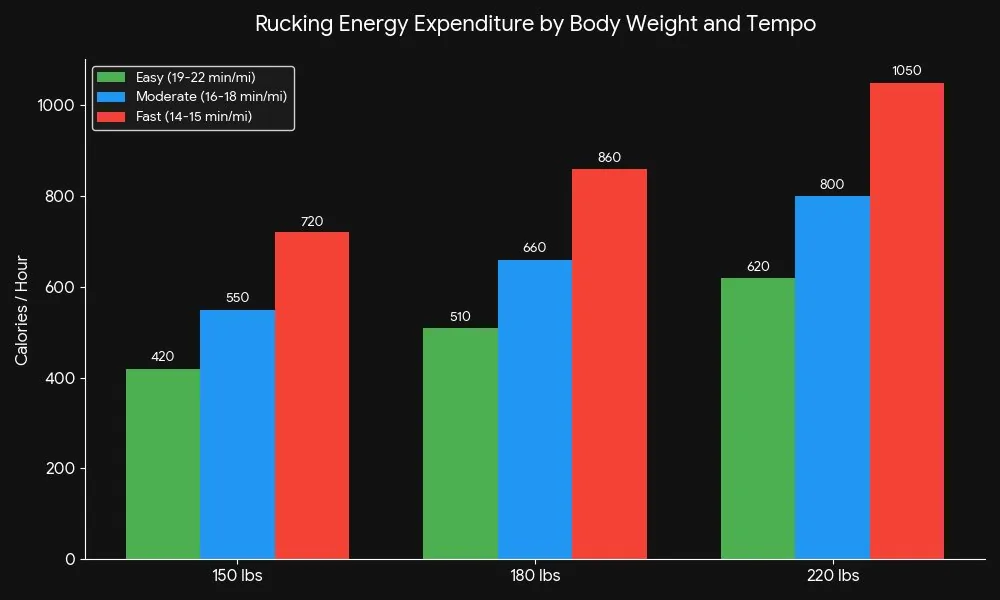
Pack weight raises energy expenditure, but at a fixed pace its effect is smaller than most people expect. Pace and grade are the larger levers, which is why the figures below sit close together and then climb sharply once you add speed or hills.
| Ruck Weight | Calories per Hour | Calories per Mile |
|---|---|---|
| 20 lbs | ~520 | ~130 |
| 30 lbs | ~540 | ~135 |
| 40 lbs | ~565 | ~140 |
| 50+ lbs | ~605 | ~150 |
How the Rucking Calorie Goal Calculator Works
Understanding the Calculation
Our calculator uses a proven formula that accounts for three key factors: your body weight, ruck weight, and training duration. The baseline metabolic rate is enhanced by the additional load you carry, creating a more accurate estimate than standard walking calculators.
Factors That Affect Calorie Burn
Body Weight: Heavier individuals burn more calories during the same activity because they expend more energy moving their mass.
Ruck Weight: Each additional pound of ruck weight increases calorie expenditure by approximately 5 calories per hour. This is why progressive overload is effective for weight loss.
Pace and Terrain: Walking at 3-4 mph on flat terrain provides the baseline. Hills, uneven ground, and faster pacing can increase burn rates by 20-40%.
Duration and Frequency: Consistency matters more than intensity. Regular 60-90 minute sessions 3-4 times per week produce better long-term results than sporadic intense efforts.
Tips for Reaching Your Rucking Calorie Goals
Start Conservatively
Begin with lighter loads (10-15% of body weight) and shorter durations. Gradually increase either weight or duration, but not both simultaneously. This prevents overuse injuries while building the conditioning needed for higher volumes.
Combine with Nutrition
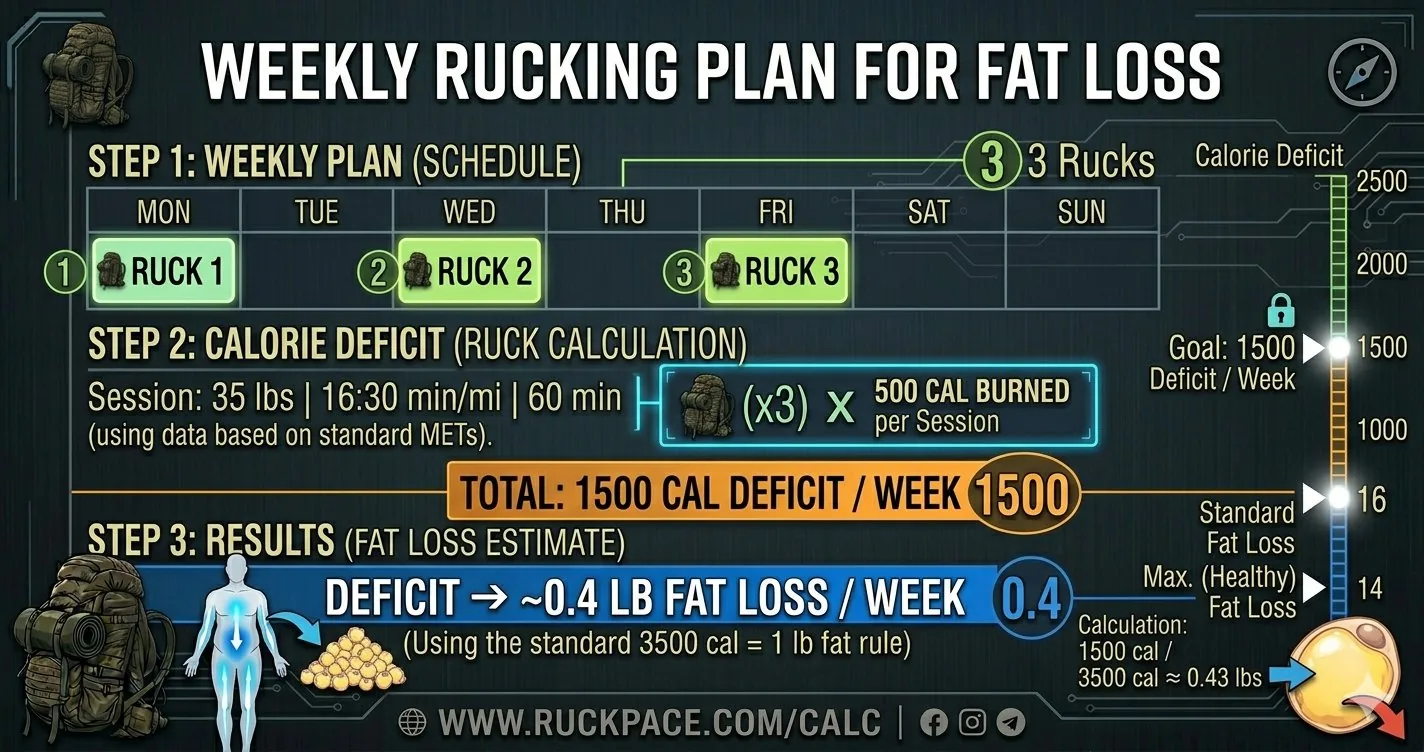
While rucking burns significant calories, combining it with a modest calorie deficit (300-500 calories daily) accelerates weight loss. Aim for a combined deficit of 500-1,000 calories per day for healthy 1-2 pound weekly loss.
Track Your Progress
Use fitness apps or journals to monitor distance, duration, and perceived effort. This data helps you adjust your training plan and stay motivated as you progress toward your goals.
Prioritize Recovery
Rucking is load-bearing exercise that stresses joints and connective tissue. Include at least one full rest day between sessions, especially when starting out or increasing volume significantly.
Frequently Asked Questions
How accurate is the calorie calculation?
The calculator provides estimates based on research-validated formulas. Individual variations in metabolism, fitness level, and movement efficiency can affect actual calorie burn by 10-15%. Use the results as a guide and adjust based on your real-world progress.
Can I ruck every day?
While technically possible, daily rucking isn't recommended for most people. The repetitive impact and load bearing requires recovery time. Most successful programs include 3-5 rucking sessions per week with rest or active recovery days between.
What if my goal requires too many sessions?
If the calculator suggests more than 6 sessions per week, consider reducing your ruck weight to allow more sustainable volume, or incorporate a calorie deficit through nutrition. Extremely high training volumes increase injury risk and can be difficult to maintain long-term.
How long until I see results?
Most people notice improved endurance within 2-3 weeks. Visible body composition changes typically appear after 4-6 weeks of consistent training combined with proper nutrition. Weight loss should be gradual and sustainable at 0.5-2 pounds per week.
How We Calculate Calories Burned
This calculator does not use a flat per-pound rate. It estimates energy expenditure with the Pandolf load-carriage equation, the model the US Army Research Institute of Environmental Medicine developed to predict how much energy a soldier burns marching with a pack. The equation takes your body mass, the load you carry, your walking speed, the terrain, and the grade, and returns a metabolic rate in watts that converts to calories per hour.
The training-plan figures above assume a standard 4 mph (15 min/mile) pace on flat, mixed terrain, which matches the pace used across most military ruck standards. Your real burn rises with a heavier pack, a faster pace, or hills, and drops on easy walks with a light load. Because everyone's metabolism and movement efficiency differ, treat the result as a planning estimate that is typically accurate within about 10-15 percent, and adjust from your own progress.
One caveat worth knowing: more recent US Army research (the Load Carriage Decision Aid, Looney et al. 2022 and 2024) found that the original Pandolf equation can underestimate the cost of very heavy loads. If you routinely ruck with 45+ lbs, your true burn may run slightly higher than the figure shown here.
References
- Pandolf KB, Givoni B, Goldman RF. Predicting energy expenditure with loads while standing or walking very slowly. J Appl Physiol. 1977;43(4):577–581.
- Looney DP, Lavoie EM, Vangala SV, et al. Modeling the metabolic costs of heavy military backpacking. Med Sci Sports Exerc. 2022;54(4):646–654. doi:10.1249/MSS.0000000000002833.
- Looney DP, Lavoie EM, Notley SR, et al. Metabolic costs of walking with weighted vests. Med Sci Sports Exerc. 2024;56(6):1177–1185. doi:10.1249/MSS.0000000000003400.
- Looney DP, Santee WR, Hansen EO, et al. Estimating energy expenditure during level, uphill, and downhill walking. Med Sci Sports Exerc. 2019;51(9):1954–1960.